
I saw a “debate” on YouTube between Richard Dawkins and Jordan Peterson which proceeded pretty much as expected. One comment that struck me as particularly ironic was when Dawkins accused Peterson of being “drunk on symbolism”. What is science (exemplified in Dawkins) if not a system of formulas, equations, calculations, hypotheses, theories, methods, in a word - symbols? How is Dawkins not drunk on his own symbols? What Dawkins does not seem to understand is this: Science only buys you precision of measurement. Accuracy is a matter of definition. And it matters not very much what kind of instrument or method we place between ourselves and what we observe, all observations are ultimately abstractions, and theory-driven abstractions at that. I suppose we could add reproducibility (and hence a kind of reliability) to the boons of science. But then, this is what defines an expert: Someone who reproducibly makes the same mistake over and over again. Dawkins (and all other naïve realists) are still confined to Plato’s cave staring at the shadows on the cave wall. The shadows can be as colorful, artful and sophisticated as you like, they are still shadows. Or so we’re told.
But we’re in a bit of a bind here, as our naïve realist scientist friends have to convince us that what we see is what there is (as they have convinced themselves), while our postmodern deconstructionist friends want us to believe that this is not so. The naïve realist needs determinism and structure, but structuralism is dead, damn it! DEAD! (Jaques Derrida) There MIGHT be something out there, but we’ll never know it. All the while the deconstructionists actually live like a naïve realist while maintaining the opposite. The car starts and stops (more or less reliably) all the while it is just a narrative element in someone’s network of power that they wield to force you to get to the store and buy their useless product and enslave you to consumerism and thus oppress you. But these power networks are also narrative elements with no meaning or purpose. It leads to problems. We’re born that way, unless we’re not.
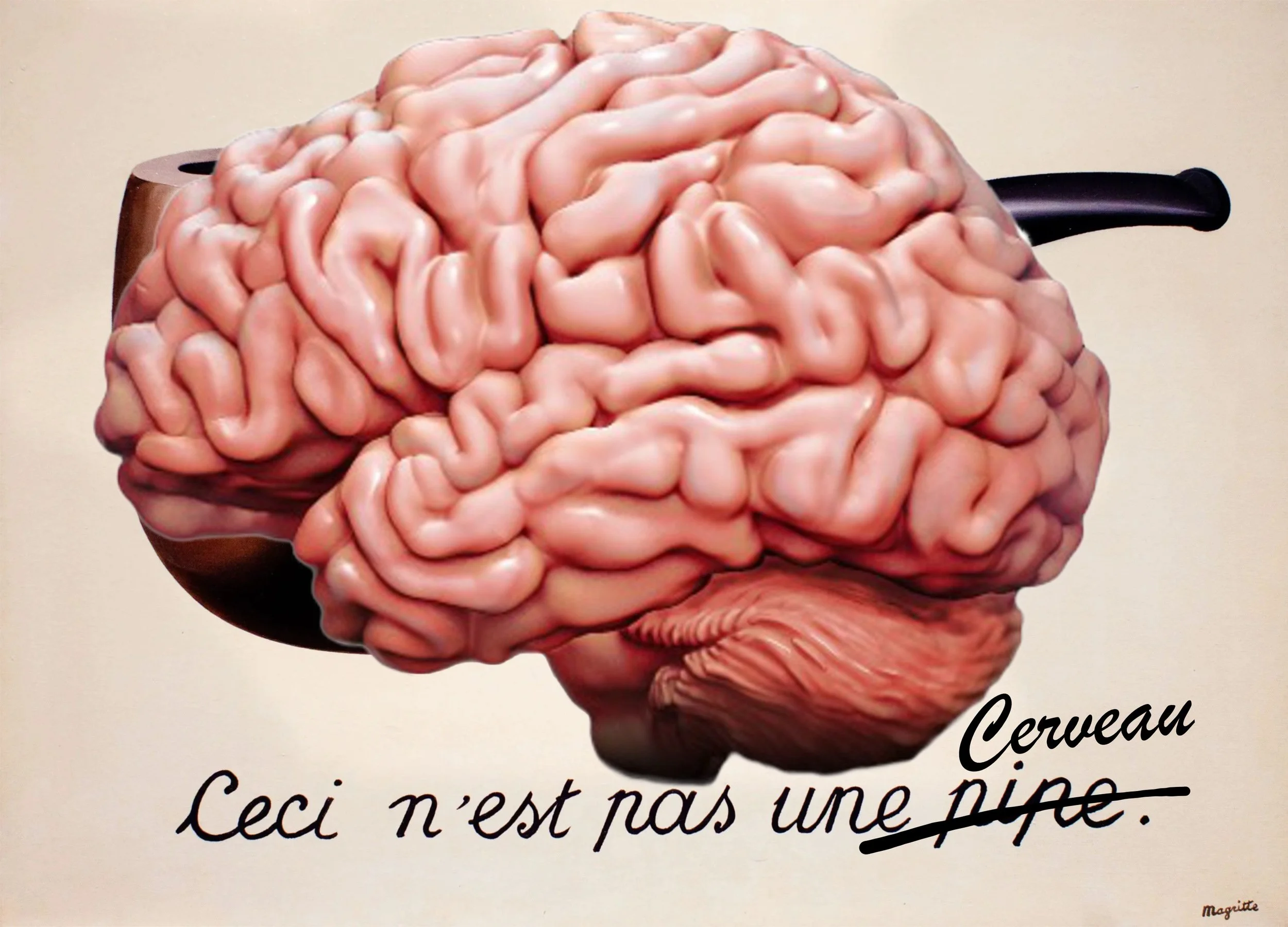
So, how do we unravel this? We think, therefore we must be, right (to paraphrase Descartes)? You gotta hit bottom in the process of systematic doubt sooner or later? One would think. Let’s start with Dawkins and the rest of the naïve realists: Their problem is with explaining how the brain does what it does. There is no little man inside our heads putting everything together, the homunculus. (if there were such a thing, there would have to be a homunculus inside the homunculus, etc). Dig around the brain as much as you like (and people have done this), there are no objects, representations or symbols in there that we can see. We assume there are, but we can’t find them. Still, the brain relates itself to not only whatever there is outside our selves but also to the brain itself. I have taken liberties with Magritte’s famous painting to illustrate the point: “Brains”, as we actually know them, are themselves constructs. And yet we have them, we think.
So, the naïve realist has a problem, and from what we know of neuroscience, the deconstructionists (and I am not making Peterson out to be one, by the way) seem to have the upper hand. What our brains seem to do is abstract from sense experience in order to direct action. Thomas Nagel (1974) made a fundamental contribution to our understanding of this limitation when he discussed “What it is like to be a bat”. (Spoiler: We’ll never know). Brains make worlds (Goodman 1978, Bruner 1985) and systematizes this creation into some kind of structure (? Narratives) that seem to reliably facilitate action, on average successfully, one would hope. The scientist should be content with that, leave the ultimate reality of the “outside world” be what it is, and acknowledge not only the impenetrability of said “outside world” but also their own fundamental ignorance of it. But, in their hubris, they tend not to do that. For the guy with the hammer not only will everything else remain a nail, but nailing things will remain the only game in town.
To be fair, our brains have been phenomenally successful in acting reproducibly and successfully on whatever it is that is “out there”. The species of homo Sapiens has not only survived for a very long time, but it has also invented wheels, cured diseases, gotten to the moon and back…, the list goes on. So, we can forgive the scientist a certain pride of accomplishment, but when it comes to addressing the “ultimate” questions, certainly the existence (or not) of God, maybe a little humility would be in order?
On the deconstructionist side, let’s keep in mind that this process of narrative-generation has led to some infelicitous consequences, like historic inevitability with gulags and killing fields, Aryan supremacy with Auschwitz and lebensraum to the east, not to mention segregation and racial bigotry, Jonestown with adulterated Coolaid, unborn children slaughtered on an industrial scale as stateless, parasitic non-persons, and our bodies as merely manipulable meat-Lego (Harrington 2023) enslaved to some nebulous disembodied self. Nothing is really given, all is a created abstraction. Or, so the story goes.
The work of Bruner and company (beautifully creative as it is) is clearly based on a deconstructionist perspective that presupposes the Nagel-ian impenetrability of the “outside world”. But this postmodernism is itself a mental construct with no external objective reality (for there can be no such thing). In fact, as my Magritte rip-off illustrates, even what we think is “a brain” is a mental construct! Our understanding of brains as narrative-generators. springing from genetics, individual backgrounds and experiences embedded in neural networks that are rewired and adjusted to render a coherent narrative that satisfies some limbic need for completion, wholeness and successful action (deep breath here) is itself a narrative construct... External reality has been deconstructed away, including our brains.
But wait, there’s more: The deconstruction goes further. Take feminist “research” which is defined as necessarily “anti-positivist” and “anti-logic” (Hesse-Biber 2014), as positivism and logic are clearly instruments of male oppression of women. No wonder, then, that we can cobble together (construct) our own individual “realities” as so many pieces of meat-Lego (Harrington 2023) or even “embed” humanness in a silicone-based device (computer). I suspect, that this enterprise will not result in a lightness of being (itself unbearable, Kundera 1984) but a crushing weight no one will be able to bear (Noble 2021). What starts off as a quest for liberation from enslavement to the species (de Beauvoir 1953) becomes a complete dissolution of the self. What starts as an enlightenment determinism a-la Newton, dissolves into a flux of quantum gravity and energy fields (Rovelli 2017. But see Klavan 2024 for an interesting discussion)
What shall save us from this wretched state we are in? Perhaps accepting that in order to understand anything we need a starting point outside ourselves? Perhaps we need a revelation? Perhaps a God that structures things according to a design and makes these structures transparent to our understanding in virtue of their very structure? Then, maybe, we can bootstrap ourselves to something, - something marvelous.
Or, maybe we did that already?