
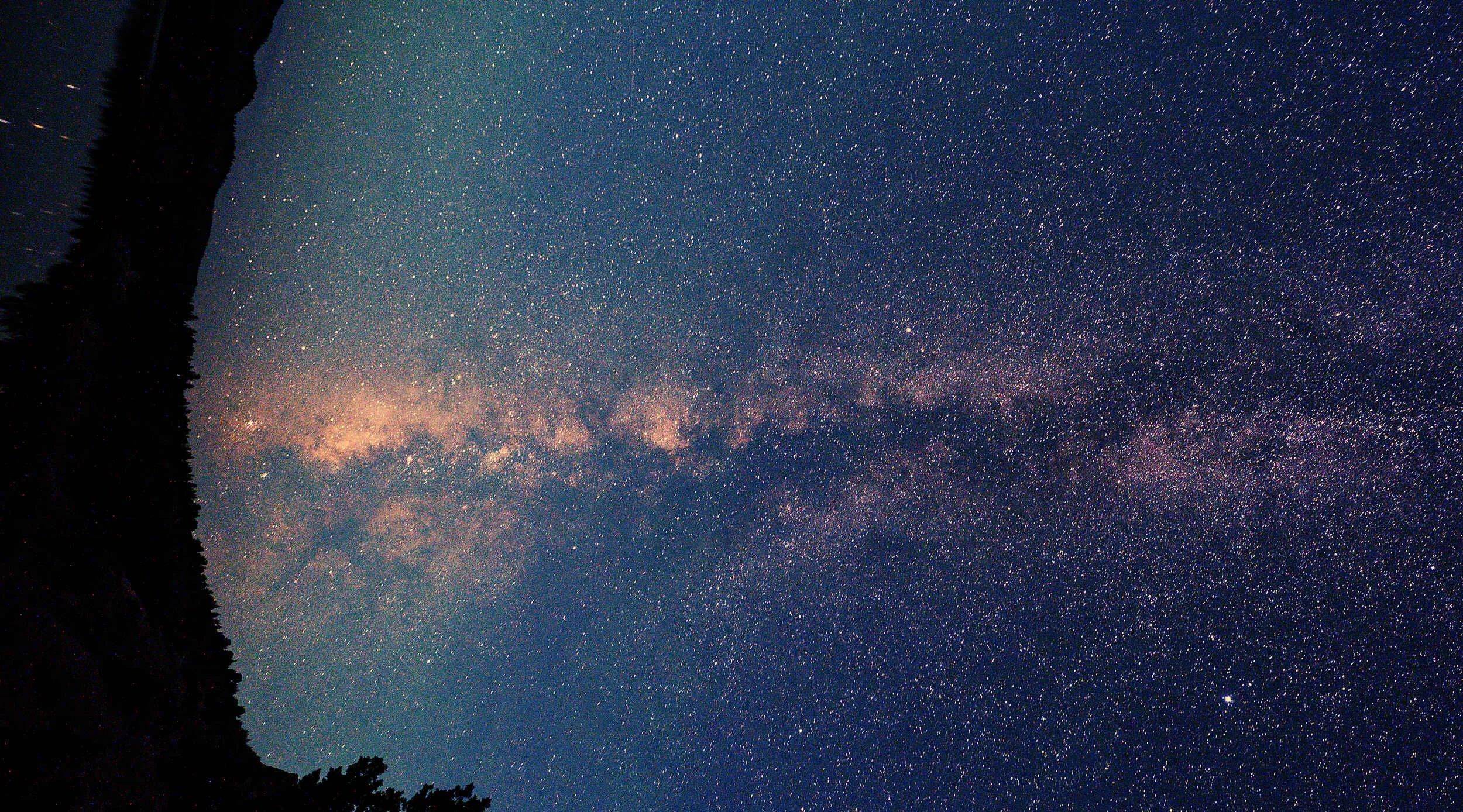
So, my trusty reader suggested talking about some of the pictures I post. See prior post on thoughts on that, but in general a good idea I think. This particular photo is a first step in doing some astrophotography, which is cool, technical, exacting, difficult and a bit unpredictable. The kind of thing I love! The main issue is you need clear skies and little to no light pollution. Try to find that today. In the Pacific Northwest! But, sometimes you luck out and the stars align. Literally and figuratively. THEN, you need a night where the full moon doesn’t obscure the stars with its brilliance and the time of year where the particular target you are interested in is in the proper position. The milky way, as here, is a favorite, Usually this means in the dead of winter and in the middle of the night. Burr!
I invested in a star tracker which is great for astro at lower magnification (ie: ≤200mm lens) though not so great for a telescope, so I’ve not invested in any fancy optics, just my usual photography kit. The trick is to compensate for the rotation of the earth so you get crisp, dot-like stars with deep color resolution (despite the apparent “blackness” of the night). The problem with THAT is the earth gets blurry since your camera is moving counter to the earths rotation and holding a fix on the stars. So you wind up with one shot for the foreground then a series of shots for the stars that you all stack together in post-processing. Like I said, technical, difficult, finicky, - FUN.
This particular shot was taken on the north rim of the Prineville Reservoir in central Oregon. It was a warm, beautiful night. For a change. I was far enough from Redmond/Prineville and there were no other people in the campground, so that light pollution was minimal. You’ll notice a couple of things:
1) There is some streaking of the star-reflections in the lake to the left in the picture. This is because this is a single, tracked shot and I did not blend in a separate foreground shot. So a little blurry there.
2) You’ll notice the orientation of the ground. Yeah: It’s vertical, not horizontal. This was my main idea with the shot: To render our earthly position relative to the larger context we’re in. The milky way, our galaxy, is horizontal, as it would be for a space traveler flying through it, looking at our earth as a ball, face on. Much like the “Earth Rise” shot the Apollo astronauts took of the earth from lunar orbit in ’68.
It puts me in my place.